

Why Horses Make Great Partners for Veterans
A horse responds to what you bring into the arena. If you walk in tense, they notice. If you slow down and breathe, they notice that too. Equines read body language, energy, and intention with remarkable accuracy, and they answer honestly every time.
For veterans, that kind of connection can mean a great deal.
Military service asks a lot of people. Many veterans come home carrying experiences that are hard to put into words, and the transition back to civilian life brings its own challenges. Some live with physical injuries, others with the invisible weight of PTSD, anxiety, or depression. Many miss the sense of purpose and the tight-knit team that defined their time in uniform, and isolation can grow with time and age. These struggles rarely look the same from one person to the next, and they’re often carried quietly.
As Veterans Day approaches this November, we’re reflecting on what we’ve learned from the veterans who have spent time with our staff and herd, and on why horses can be such meaningful partners for veterans and for the many other groups we serve.
Equine-Assisted Learning (EAL) is a hands-on way of building life skills by working directly with horses. Most sessions take place on the ground rather than in the saddle, and each one is planned around the goals of the group taking part.
The lessons focus on practical skills such as building trust, showing respect, communicating, practicing self-control and mindfulness, developing leadership skills, setting boundaries, and working as a team. You can’t force a 1,000-pound animal to follow you. You must earn its cooperation, and a horse gives honest, immediate feedback on how that’s going.
Horses are herd animals, and life in a herd runs on awareness, communication, trust, and clear boundaries. When people step into that world, whether grooming, leading, or simply standing nearby, they start practicing those same skills. As Agape likes to say, you’ll learn a little about horses and a lot about life.
Veterans are a growing part of equine-assisted services nationwide. PATH International, the field’s leading credentialing organization, supports more than 53,300 people each year through its member centers, including nearly 6,000 veterans.
Research is still developing, and it’s encouraging. A 2023 review published through the National Institutes of Health found that early results suggest equine-assisted services may help veterans by increasing their engagement in treatment and strengthening their relationship with care providers, while also contributing to symptom reduction. A 2021 study of equine-assisted therapy for veterans with PTSD found that just over half of participants showed clinically significant improvement in their symptoms, and fewer than 8% dropped out.
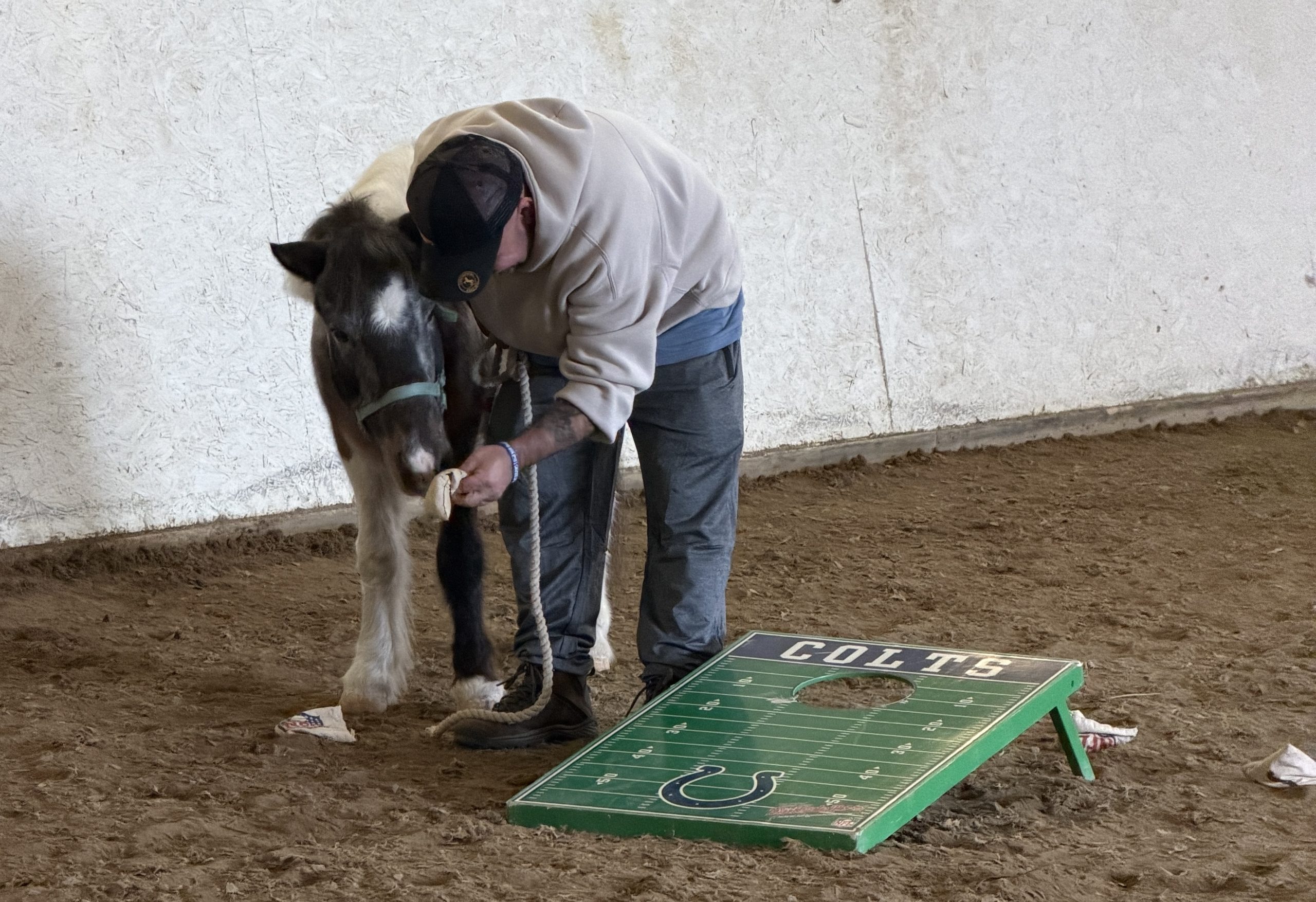

Agape saw that connection firsthand this past session, when a group of military veterans joined us for an EAL program. Their goals were building relationships, collaborating, expressing needs, and practicing self-care, and the activities were designed to stretch them in each area, both alongside their horses and on their own.
“During a lesson focused on trust, veterans took turns guiding one another through a course while blindfolded and leading a horse,” said Jackie Nordmann, Program Coordinator at Agape. “One participant compared it to driving a military vehicle in the dark during his Army service. In both moments, he couldn’t control everything and had to trust the people around him.”
Grooming became one of the group’s favorite parts of every visit. While brushing their horses, veterans learned simple massage techniques and stretches, then talked about how caring for a horse mirrors the care we owe ourselves. The idea stuck, so much so that the group returned to it every week.
“Grooming seemed to be a popular activity among the veterans,” reflected Kaci Rose, Program Manager at Agape. “They could sit and just be with their horse on their own time, giving them love and learning how to give that back to themselves. We watched veterans who may have had a tough exterior open up to us and to their equine friends.”


Other lessons brought out the laughter. To build leadership and communication, the group played a game of Twister with their horses. It was a genuine challenge, and everyone persevered through it. The program wrapped up with a game day with activity stations, plenty of time with the full herd and the minis, and the freedom to choose how to spend it. After weeks of structured lessons, veterans especially appreciated the trust to simply be with their horses on their own terms.
We’re grateful for the chance to support those who have so selflessly served our country.
Every group is different, so Agape offers options for meeting the horses in whatever setting works best.
At the barn, groups can join an EAL program that meets weekly and builds skills session by session, or book a one-time Agape Experience to spend time with the herd at our Cicero facility.
Away from the barn, Mini Visits bring our miniature horses directly to senior living communities, schools, care facilities, and organizations across Central Indiana. A PATH Certified Instructor and trained volunteers handle everything on-site, indoors or outdoors, as a one-time visit or a recurring one. For groups that can’t host in person, virtual visits are available too.

If you’re exploring EAL for a veterans organization, school, treatment program, or community group, here’s what to know. Groups are capped at 12 people per session so everyone gets enough time with the horses. Programs serve elementary-aged youth through adults, and each curriculum, such as Employment Skills, Mindfulness, Thinking Outside the Box, and How to Be Awesome, is shaped around your group’s goals. You don’t need any experience with horses, just a willingness to learn and grow.
Bring your group to the barn.
Inquire about Equine-Assisted Learning
Invite the horses to you.