
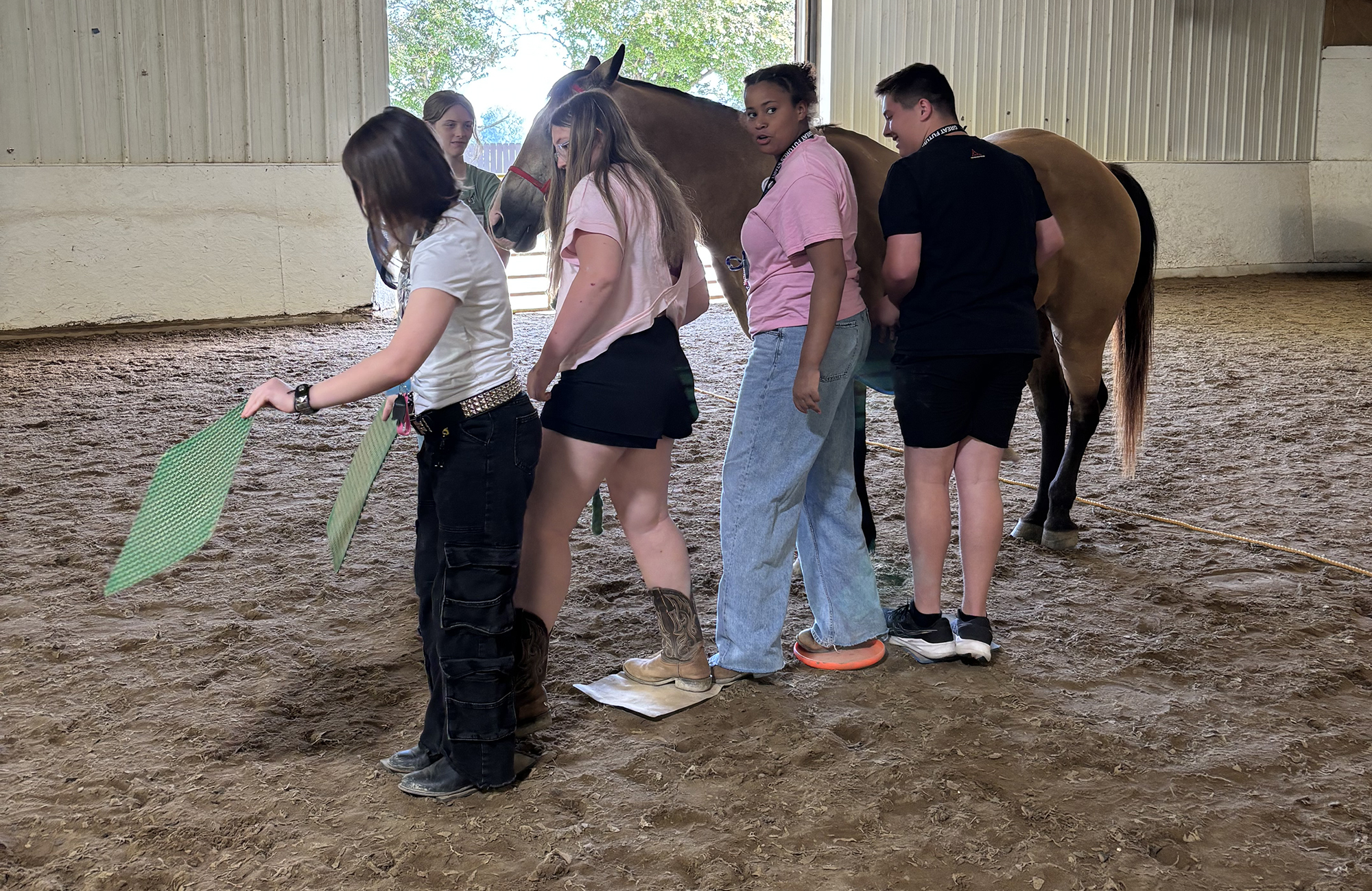
Some life skills can be difficult to understand through conversation alone. Concepts such as personal boundaries, emotional regulation, teamwork, and self-confidence often become more meaningful when participants have an opportunity to experience them firsthand.
At Agape, equine-assisted learning gives participants that opportunity through purposeful activities with horses. Because horses respond naturally to human emotions, body language, and behavior, they can provide immediate feedback that helps participants better understand themselves and their interactions with others.
Through these experiences, participants can practice valuable skills in a supportive environment before applying them at school, at work, in relationships, and throughout their everyday lives.
What makes learning with equines different?
In a traditional classroom or group setting, growth often relies heavily on discussion and self-reflection. Horses add a physical, immediate dimension to the learning process.
A horse may respond when someone approaches with tension, acts impulsively, or communicates without confidence. Participants can observe that response and adjust their behavior in the moment. For individuals who have experienced trauma, think or learn differently, or have difficulty recognizing how their emotions affect others, this feedback can make an abstract concept easier to understand.
Horses also offer opportunities to experience the positive effects of responsibility and care. Grooming, leading, and interacting with an equine partner can help participants slow down, focus on the present moment, and recognize how their actions affect another living being.
This hands-on approach creates new pathways for learning while helping participants build trust in themselves and their abilities.
What happens during a session at Agape?
A typical session begins in Agape’s observation room, where participants discuss the skill or theme they will explore that day. If the focus is responsibility, for example, the group may consider what responsibility means, who they are responsible for, and what other skills help someone act responsibly.
This initial conversation establishes a foundation before the group enters the aisle or arena. Participants then complete activities designed to help them process, practice, and strengthen the skill they discussed.
Some activities begin with participants working together before an equine friend becomes involved. Others introduce the horse earlier in the process. In either case, each experience gives participants an opportunity to work through challenges and receive natural feedback from their peers and equine partners.
Mounted activities may also be incorporated toward the end of the group’s time at Agape. These experiences bring together the communication, leadership, and other skills participants have practiced while offering an educational celebration of their progress.
Equine-assisted learning activities that build life skills
Activities are selected based on the group’s goals, abilities, and individual needs. Agape may incorporate exercises such as:
- Connect by Balls: Participants travel across the arena while remaining connected by bouncy balls placed between them. Because they cannot use their hands, they must communicate, cooperate, and adjust to one another.
- Raging River: Group members work together to cross a “river” created by rope lines, using objects on the ground as stepping points. The activity encourages planning, perseverance, teamwork, and problem-solving.
- Team Penning: Participants guide equine partners into designated areas using only their voices and body language. This activity helps them practice clear communication, leadership, patience, and self-control.
- Grooming and massage: Participants care for a horse by brushing, picking its feet, or gently working its muscles. Along with promoting self-care and mindfulness, this experience provides a physical example of how to establish and respect personal boundaries.
These activities may intentionally create moments of uncertainty or frustration. With support from Agape’s instructors and their equine partners, participants learn to pause, communicate their needs, try a different approach, and continue working toward a goal.
Learning to set and respect boundaries
Horses communicate their comfort levels through subtle movements and body language. During grooming and other activities, participants learn that a horse has personal space and is allowed to communicate when that space is being crossed.
If someone moves too close, the horse may turn its head away, shift its body, or offer another subtle signal. Participants learn to notice and respect those signals.
This communication works both ways. When a horse enters a participant’s personal space, the participant can use calm, clear body language to ask the horse to move away. The experience helps participants understand that they also have a right to establish their own boundaries.
Over time, participants may become more confident in expressing their needs and respecting the needs of others. Working with a horse turns boundary-setting from an abstract idea into something they can see, feel, and practice.
Adapting each experience to the group
Every group arrives at Agape with different strengths, challenges, and goals. Some organizations identify specific areas they would like to address, while others rely on Agape’s instructors to determine where participants may benefit from additionalgrowth.
A youth support group, for example, may focus on responsibility, communication, and teamwork. A group of veterans who already demonstrate those skills may work instead on self-care, mindfulness, or anger management.
Agape’s PATH Intl. Certified Therapeutic Riding Instructors use these goals to plan a curriculum in which each activity builds upon the last. They also consider which activities and equines are the most appropriate fit. Some participants may feel most comfortable beginning with Agape’s miniature horses, while others may benefit from working with full-sized equine partners.
This flexibility allows Agape to meet participants where they are while creating meaningful opportunities for continued growth.
Carrying new skills into everyday life
The connection between the arena and daily life is woven throughout each session. Participants begin by discussing how they currently use a skill, practice it through an activity, and then reflect on how they can continue using it outside Agape.
A participant may use deep breathing to remain calm during an argument, remember to ask before touching someone, or follow the steps of problem-solving when an issue arises at school or work. Veterans have also shared that self-regulation techniques practiced at Agape helped them recognize and manage strong emotions during stressful situations.
The impact can be visible even within a single session. A child who arrives overwhelmed may begin to pause and take deep breaths without being prompted. Someone who is quiet in the observation room may enter the arena, communicate with teammates, offer feedback, and step into a leadership role.
Returning participants from the Noblesville Youth Assistance Program, or NYAP, also demonstrate how these skills grow over time. They remember safety expectations, confidently handle miniature horses, and draw upon strategies they practiced during previous visits.
Progress does not always look like a dramatic transformation. Sometimes, it is a child taking a breath instead of reacting, approaching a horse they were once nervous to meet, speaking up when they need something, or realizing they are capable of solving a difficult problem.
Growth that extends beyond the arena
There is always something new to learn through equine-assisted learning at Agape. Each activity can be adapted to participants’ goals and abilities, creating space for individuals and groups to practice skills in a way that feels engaging, natural, and meaningful.
The small moments participants experience with their equine partners can add up to lasting change. With time and practice, the communication, confidence, mindfulness, and problem-solving skills developed at Agape can become tools they carry into their homes, schools, workplaces, and relationships.

